
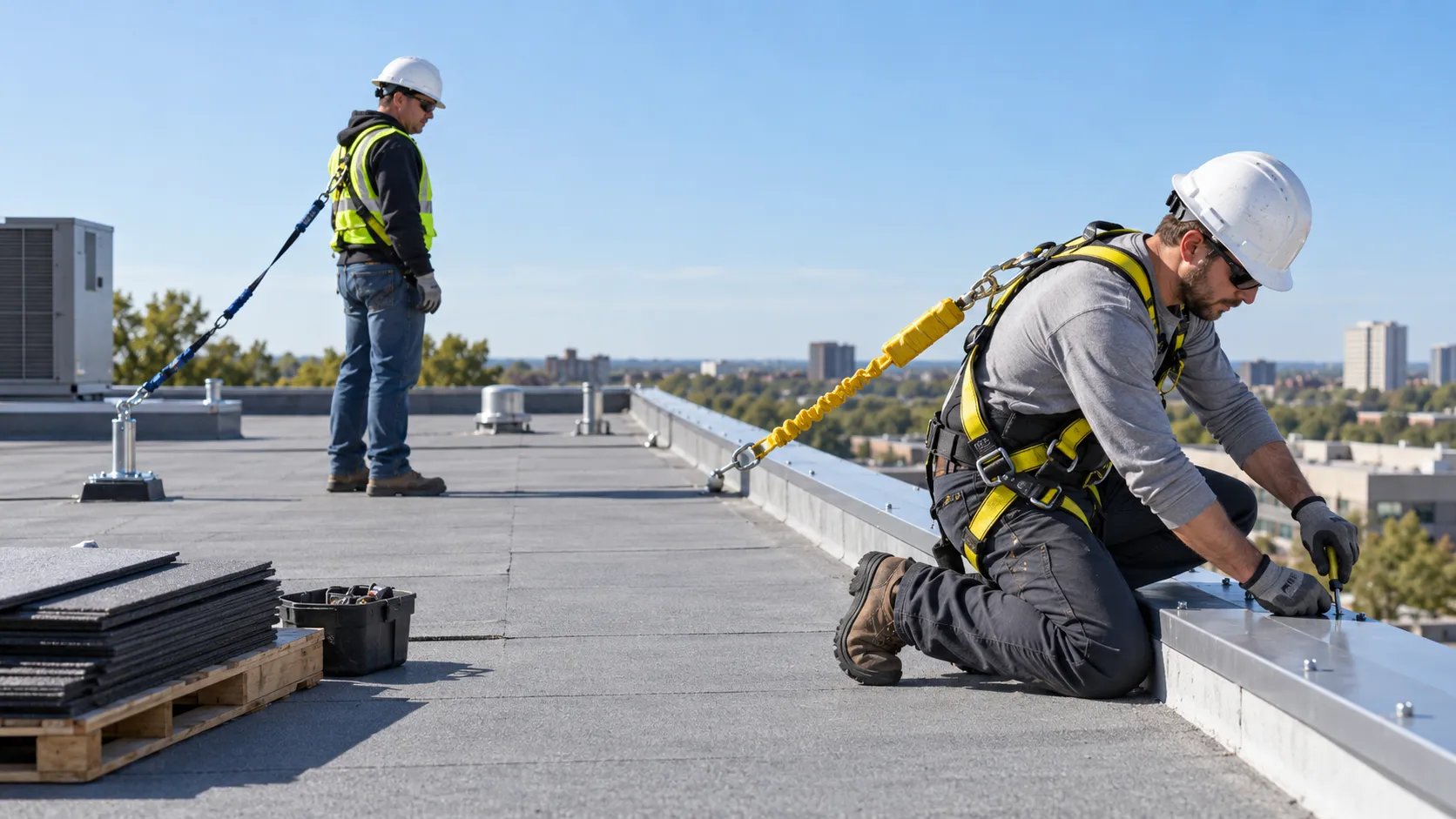
- Alberta's OHS Code sets an order: guardrail, then travel restraint, then personal fall arrest, then equally effective controls, each only when the one before it is not reasonably practicable.
- Travel restraint keeps a worker from reaching a fall-risk edge. Personal fall arrest stops a fall that has already started.
- Fall arrest needs a full body harness, a shock absorber (with exceptions), stronger anchors, enough clearance below and a plan to rescue a suspended worker.
- After a personal fall arrest system has stopped a fall, the Code requires it to be removed from service.
- Fall arrest training is a legal topic as well as a skill, because the Code lists arresting force, swing fall and free fall as required training content.
In Alberta, travel restraint comes before fall arrest. Section 139 of the Occupational Health and Safety Code tells an employer to use a guardrail first, then a travel restraint system if a guardrail is not reasonably practicable, and a personal fall arrest system only if travel restraint is not reasonably practicable either [1]. The reason is simple: a restraint system stops a worker from reaching the edge at all, while an arrest system assumes a fall will happen and tries to stop it safely. Fall arrest training matters because the second approach carries far more equipment, anchor and rescue demands than the first.
The Order Alberta's Code Puts Them In
Section 139(1) sets when protection is required, including any possible fall of 3 metres or more. Subsections 139(3) to (7) then set the order of preference [1]:
- Guardrail. An employer must install one.
- Travel restraint system. Required if a guardrail is not reasonably practicable.
- Personal fall arrest system. Required if a travel restraint system is not reasonably practicable.
- Equally effective controls. Required if a personal fall arrest system is not reasonably practicable.
A worker must then use whichever system the section requires (s. 139(8)) [1]. In other words, personal fall arrest is not a free choice that sits beside travel restraint on the shelf. It is the next step down when restraint cannot be arranged. The fall protection plan and the hazard assessment are where that reasoning gets recorded for a specific job.
What Each System Does
Part 1 of the Code defines the two terms [2]:
- A travel restraint system is "a type of fall protection system, including guardrails or similar barriers, that prevents a worker from travelling to the edge of a structure or to a work position from which the worker could fall."
- A personal fall arrest system is "personal protective equipment that will stop a worker's fall before the worker hits a surface below the worker."
Notice what the first definition includes: guardrails and similar barriers count as travel restraint in the Code's own language. The second definition is about equipment worn by the worker that does its job only after a fall has begun.
The Code also names other fall protection systems in the same definition, including safety nets, leading-edge fabric or netting panels, control zones and procedures in place of fall protection equipment [2]. Those sit outside this comparison, but they explain why "fall protection" is the umbrella term and "fall arrest" and "travel restraint" are two specific tools under it.
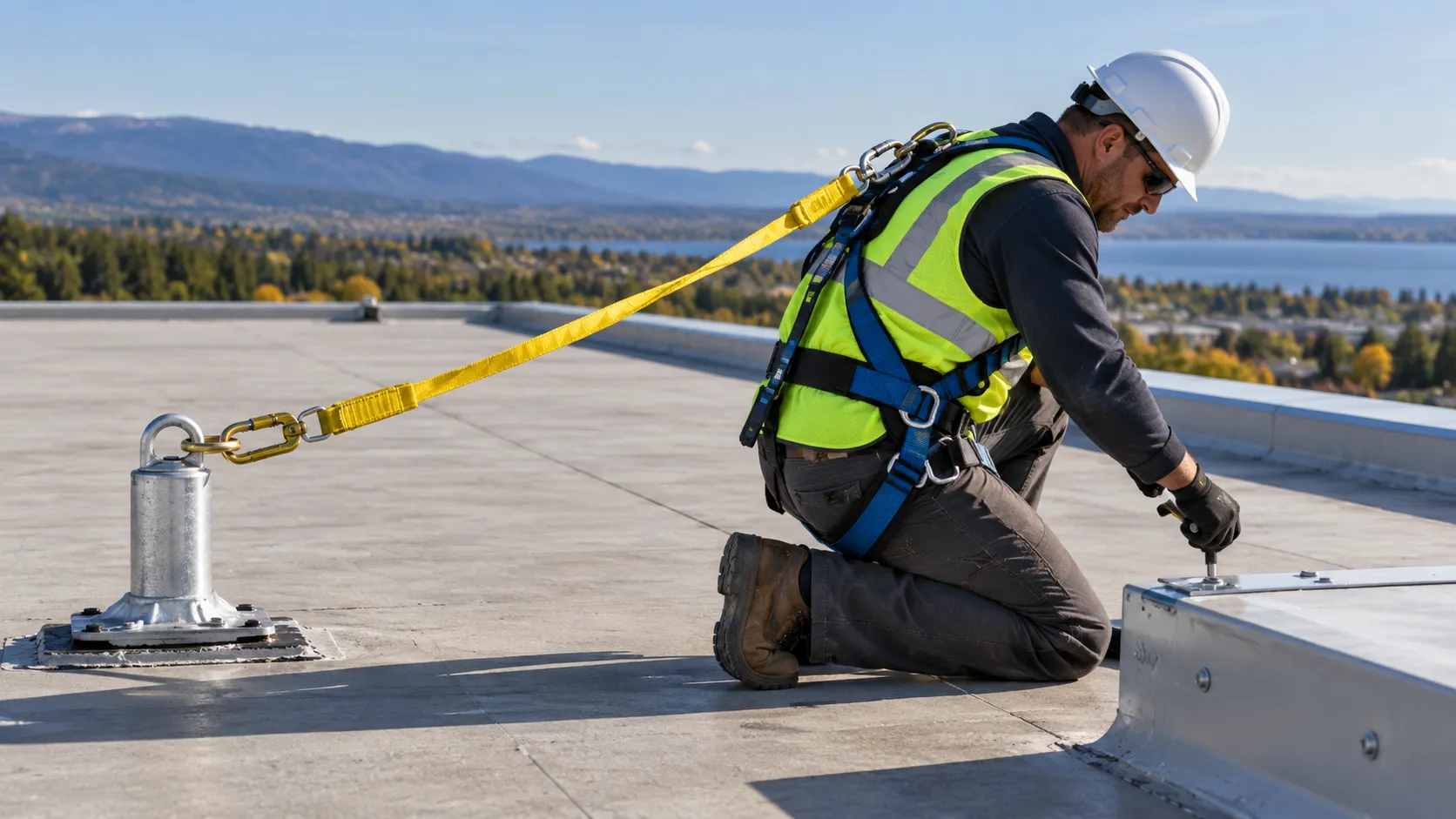
Fall Arrest vs Travel Restraint Side by Side
| Question | Travel restraint | Personal fall arrest |
|---|---|---|
| What it does | Prevents the worker from reaching the edge or position from which a fall could happen | Stops a fall before the worker hits a surface below |
| Where it sits in the Code's order | Second, after a guardrail | Third, only if travel restraint is not reasonably practicable |
| Body support | A body belt is allowed only as part of a travel restraint system or a fall restrict system | A worker must wear and use a full body harness |
| Connecting equipment | Must be compatible with the other components of the system | A full body harness and a lanyard equipped with a shock absorber or similar device, with listed exceptions |
| Temporary anchor strength | At least 3.5 kilonewtons per worker attached, permanently marked as for travel restraint only | At least 16 kilonewtons, or 2 times the maximum arresting force, per worker attached |
| Clearance below | Not a design concern, because the worker is not meant to fall | Must be arranged so the worker cannot hit the ground, a hazardous object or a level below |
| After a fall | Not addressed, because no fall is expected | The system must be removed from service and only returned if a professional engineer or the manufacturer certifies it is safe |
| Rescue | No suspended-worker rescue is expected | The fall protection plan must set out rescue procedures for a worker suspended by the system |
The table draws on sections 139, 140, 142, 142.1, 142.3, 150, 150.2, 151 and 152.1 of Part 9 [1]. The clearance, after-a-fall and rescue rows reflect where the Code attaches its requirements, which is to personal fall arrest. They are our reading of the text, not a statement that a restraint system can never be overloaded or that no rescue thinking is needed on a restraint job.
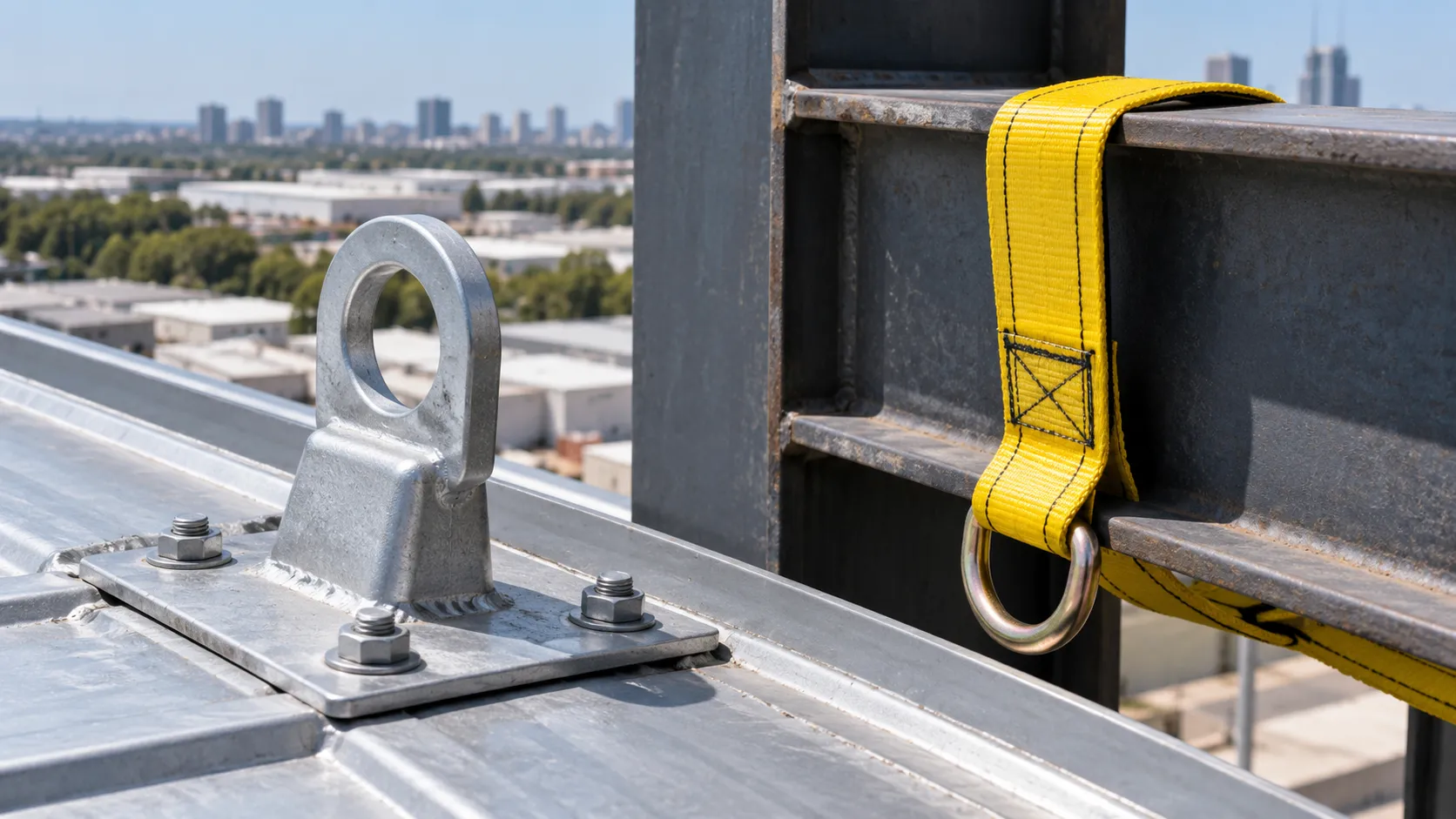
Anchors: The Practical Difference
Anchors are where the two systems separate most clearly. A temporary anchor used in a travel restraint system needs a minimum breaking strength of 3.5 kilonewtons in any direction the load may be applied, per worker attached. It must also be permanently marked as being for travel restraint only, and it must be removed from use when the work project ends or at the time the manufacturer or a professional engineer specifies [1].
A temporary anchor used in a personal fall arrest system needs a minimum breaking strength of at least 16 kilonewtons, or 2 times the maximum arresting force, per worker attached [1]. A permanent anchor has the same 16 kilonewton or 2-times test [1].
The Code does not spell out its reasoning, but the numbers suggest why the marking requirement exists. An anchor that is strong enough to hold a worker back from an edge is not necessarily strong enough to hold a falling worker, so the Code requires the lower-rated anchor to carry a permanent "travel restraint only" mark. Using the wrong anchor for the wrong system is the kind of error that training on anchor selection, a required topic under section 141(2), is meant to prevent [1].
Clearance, Forces and Rescue: What Fall Arrest Adds
A personal fall arrest system comes with requirements that a restraint system does not need, because the worker is expected to fall some distance [1]:
- The system must be arranged so the worker cannot hit the ground, an object that poses an unusual possibility of injury, or a level below the work area (s. 151(1)).
- A system without a shock absorber must limit free-fall distance to 1.2 metres (s. 151(2)).
- The system must limit the maximum arresting force on the worker to 6 kilonewtons, or 8 kilonewtons where an E6 type shock absorber is used according to the manufacturer's specifications (s. 151(3)).
- The worker must use the shortest lanyard that still allows the work, secured to an anchor no lower than shoulder height where one is available (s. 151(4) and (5)).
- After the system has stopped a fall, the employer must remove it from service, and it may not return to service unless a professional engineer or the manufacturer certifies it is safe (s. 150.2).
Then there is rescue. The fall protection plan must specify the rescue procedures to be used if a worker falls and is suspended by a personal fall arrest system or safety net and needs to be rescued (s. 140(2)(f)) [1]. A worker hanging in a harness is an emergency that needs a plan, which is why rescue planning appears in fall protection course outlines.
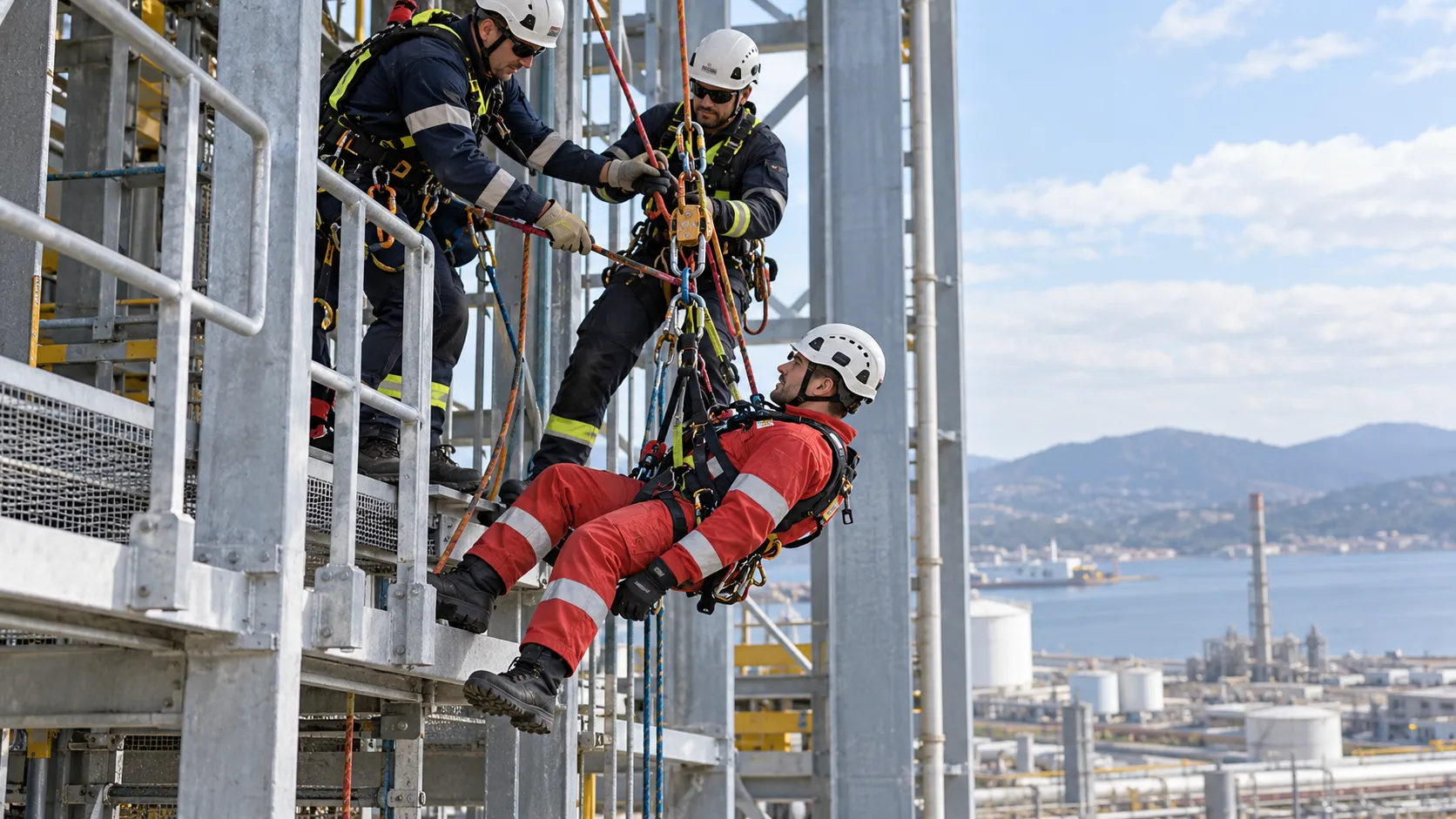
What Fall Arrest Training Should Include
Section 141(2) lists the minimum content for fall protection training, and several items bear directly on fall arrest [1]:
- identification of fall hazards;
- assessment and selection of the specific anchors a worker may use;
- the correct use of connecting hardware;
- the effect of a fall on the human body, including maximum arresting force, the purpose of shock and energy absorbers, swing fall and free fall;
- pre-use inspection;
- emergency response procedures; and
- practice in inspecting, fitting, adjusting and connecting fall protection systems and components, and in emergency response procedures.
The Safeworks Academy Fall Protection Alberta course page lists travel restraint, fall arrest and fall restrict systems, hazard assessments, equipment inspections and rescue planning among its topics [3]. A course can teach those topics online. The practice items still need a person and real equipment, and our guide to fall protection training in Alberta explains how to split the knowledge and practice parts between a course and the employer.

Which System Does a Given Job Need?
Nobody can answer that from an article, because the Code makes it depend on the work site. What the Code does give is the sequence of questions to ask, based on sections 139 and 140 [1]:
- Can the fall hazard be removed or protected by a guardrail?
- If not, can the worker be kept from reaching the edge with a travel restraint system, including a suitable anchor?
- If not, is there a suitable anchor, enough clearance below and a workable rescue plan for personal fall arrest?
- If not, what equally effective control does the employer propose?
Write the answers into the fall protection plan, review it with the workers before work begins, and treat the hazard assessment as the starting point [1][4]. If the answer to question 3 turns out to be "we cannot show clearance or rescue," that is a sign to go back to question 2.
Next Step
If you are building a crew's knowledge of how these systems differ, the Fall Protection Alberta course from Safeworks Academy covers travel restraint, fall arrest and fall restrict systems online in about four hours, at $89.95 CAD [3]. Workers who need only general awareness can look at the general Fall Protection Online Certification course [5], and other options are in the course catalogue. Our fall protection training page sums up the Alberta course in one place. Pair any course with hands-on practice on your own equipment and a briefing on your own site, because the Code expects both.
Frequently Asked Questions
Travel restraint prevents a worker from reaching the edge or position from which a fall could happen. Personal fall arrest stops a fall that has already started, before the worker hits a surface below. Alberta's OHS Code treats travel restraint as the preferred option when a guardrail is not practicable.
Yes. Section 139 of the OHS Code requires a guardrail first, then a travel restraint system if a guardrail is not reasonably practicable, and a personal fall arrest system only if travel restraint is not reasonably practicable. If fall arrest is not practicable either, equally effective controls are required.
A permanent anchor, or a temporary anchor used in a personal fall arrest system, needs a minimum breaking strength of at least 16 kilonewtons or 2 times the maximum arresting force per attached worker. A temporary anchor used only for travel restraint needs at least 3.5 kilonewtons and must be marked as for travel restraint only.
Not automatically. After a personal fall arrest system has stopped a fall, the employer must remove it from service. It can only be returned to service if a professional engineer or the manufacturer certifies that the system is safe to use.
Fall protection training is required for workers who work where a fall protection system must be used, and the required content includes anchors, connecting hardware, the effect of a fall, pre-use inspection and emergency response. A worker who uses a personal fall arrest system must be trained in it before working in the area.
Sources
- Government of Alberta — "Occupational Health and Safety Code (Alberta Regulation 191/2021), Part 9, Fall Protection (sections 138 to 161)" — search-ohs-laws.alberta.ca
- Government of Alberta — "Occupational Health and Safety Code, Part 1, Definitions and General Application" (definitions of "fall protection system," "personal fall arrest system" and "travel restraint system") — search-ohs-laws.alberta.ca
- Safeworks Academy — "Fall Protection - Alberta" course page (course by Danatec Educational Services) — courses.safeworksacademy.ca
- Government of Alberta — "Occupational Health and Safety Code, Part 2, Hazard Assessment, Elimination and Control (section 7)" — search-ohs-laws.alberta.ca
- Safeworks Academy — "Fall Protection Online Certification Training" course page — courses.safeworksacademy.ca
Disclaimer: This article is for general informational purposes and does not constitute legal or regulatory compliance advice. Employers and workers should confirm their specific obligations directly with the responsible regulator (for example Alberta Occupational Health and Safety, the Government of Alberta or Transport Canada, as applicable) or a qualified compliance professional.