
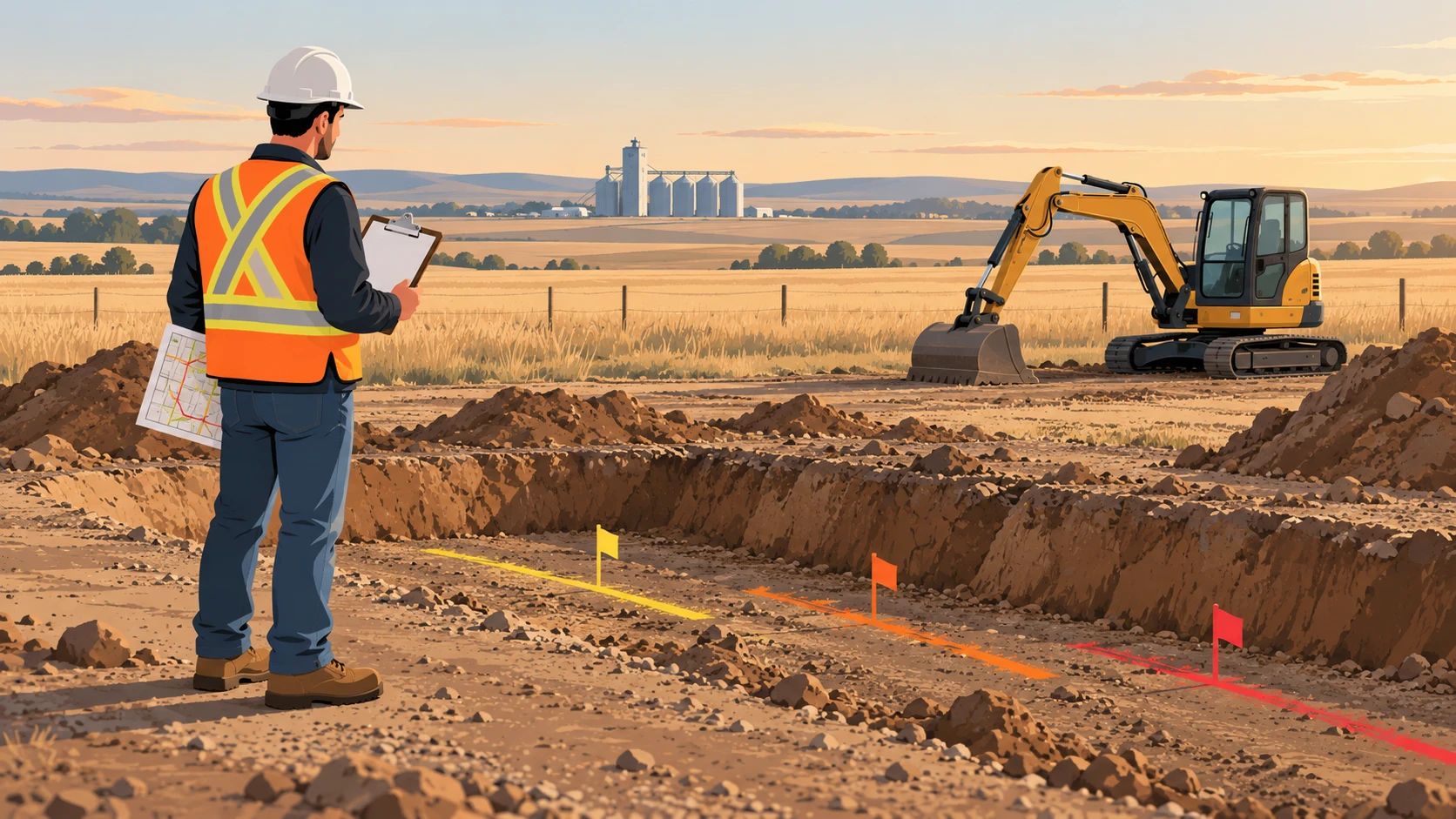
- Ground Disturbance Level II does not require Level I first — the two levels aren't sequential.
- Level II is required for anyone who supervises, independently performs, or issues and receives ground disturbance permits, including solo operators with no one reporting to them.
- Both levels are assessed against Utility Safety Partners standards (formerly the Alberta Common Ground Alliance) and are valid for three years.
- The general tolerance zone near a buried pipeline is five metres either side of the marked centreline unless closer mechanical excavation is authorized in writing.
- A valid BC or Manitoba Level II certificate can be extended to Alberta with an add-on module, but the add-on expires on the original certificate's date.
Ground Disturbance certification in Alberta comes in two levels, and they aren't sequential. Level I is an awareness-level program for workers who are directly supervised during excavation work. Level II is a supervisory credential for anyone who supervises, independently performs, or issues and receives ground disturbance permits — and it does not require holding Level I first [1][2]. Both levels are assessed against Utility Safety Partners standards, the body formerly known as the Alberta Common Ground Alliance, and Level II certification runs on a three-year validity period [1][3]. This guide breaks down what separates the two levels, what the Level II course actually covers, and how the process works if you already hold a Ground Disturbance credential from another province.
What Ground Disturbance Certification Covers
Ground disturbance certification exists because Alberta has an enormous amount of buried infrastructure — pipelines, natural gas lines, fibre optic cable, electrical conduit, water and sewer — sitting under land that gets excavated, augured, or hydro-vac'd every day [4]. A single mislocated or unmarked line can cause a fatality or a multi-million-dollar release incident, which is why the training exists in the first place, not just as a paperwork requirement [4].
Utility Safety Partners (USP), Alberta's One-Call service and the body formerly known as the Alberta Common Ground Alliance, sets the certification standards used across the province: the 101 Ground Disturbance Standard for awareness-level training, and the 201 Ground Disturbance Standard for supervisory-level training [1][5].
Level I vs. Level II: Do You Need Both?
This is the question that trips up the most people, so it's worth answering directly: no, Level II does not require Level I as a prerequisite. A worker holding a valid Level II certificate does not need to also hold Level I [4]. Employers sometimes still choose to run new hires through Level I before promoting them into a Level II supervisory role, but that's a training-progression decision an employer makes, not a certification requirement [4].
| Level I (Awareness) | Level II (Supervisor) | |
|---|---|---|
| Who it's for | Workers who are directly supervised during ground disturbance activities | Anyone who supervises, independently performs, or issues and receives ground disturbance permits |
| Standard | Utility Safety Partners 101 Ground Disturbance Standard | Utility Safety Partners 201 Ground Disturbance Standard (AB) |
| What it covers | Core hazard awareness and basic locate concepts | Full regulatory framework, the USP locate process, tolerance zone rules, and an Alberta-specific jurisdictional module |
| Validity | 3 years | 3 years |
| Is the other level required? | Not required to also hold Level II | Not required to also hold Level I first |
| Typical audience | Entry-level field workers under direct supervision | Supervisors, permit issuers and receivers, safety managers, and Gold Seal-eligible construction roles |
Who Actually Needs Level II
Level II certification applies to anyone in one of three positions: supervising a ground disturbance in progress, independently performing a ground disturbance without direct oversight, or issuing and receiving ground disturbance permits [2][5]. That covers a broader group than "supervisor" as a job title suggests — a solo operator running their own excavation without someone else overseeing them needs Level II, not Level I, even if nobody reports to them.
What the Level II Course Covers
Most recognized Level II programs are built around three modules: the Level I awareness content, an Alberta-specific jurisdictional module covering provincial requirements, and a final exam requiring an 80% pass mark [2][6]. Course content typically includes locate request procedures through Utility Safety Partners, how to interpret utility company drawings and alignments, tolerance zone requirements near buried infrastructure, and damage prevention strategies specific to Alberta [1][4]. Some Level II courses are also eligible for two Gold Seal Certification Credits through the Canadian Construction Association, which matters if you're working toward a Gold Seal credential alongside your safety certifications [1].
Tolerance Zones and the Locate Process
Before any ground disturbance activity, a locate request through Utility Safety Partners (Alberta's One-Call system) is the required first step [4]. But a locate alone doesn't protect anyone — someone with Level II training needs to actually interpret the utility company's drawings and alignments and supervise safe excavation around them [4]. The general tolerance zone for hand-exposing or mechanically excavating near a buried pipeline is typically five metres either side of the marked centreline, unless mechanical excavation closer than that has been specifically authorized in writing [4]. This is exactly the kind of detail that separates Level I awareness from Level II competency: a Level I worker needs to know a tolerance zone exists, while a Level II supervisor needs to know how to apply it and make the call on authorized exceptions.
How Long Certification Is Valid, and Cross-Province Recognition
Alberta Ground Disturbance Level II certification is valid for three years from the date of successful completion [1][3]. If you already hold a currently valid Level II certificate from British Columbia or Manitoba, you don't need to retake the full course to work in Alberta — an Alberta add-on module is available specifically for that situation [7]. The reverse is also true for Albertans working in BC or Manitoba. One detail that catches people off guard: an add-on certificate doesn't get its own fresh three-year term. It expires on the same date as your original province's certificate, not three years from when you completed the add-on [7].
Which Level Fits Your Situation
- New field worker, always under direct supervision: Level I is typically sufficient — confirm with your employer or site supervisor before assuming either way.
- Supervising, working independently, or issuing/receiving permits: You need Level II. Level I isn't a substitute, and it isn't a required stepping stone either.
- Already Level II-certified in BC or Manitoba: Look for the Alberta add-on rather than repeating the entire course — but plan around the shared expiry date, not a fresh three-year clock.
- Working toward Gold Seal certification: Confirm the specific Level II course you're taking is Canadian Construction Association Gold Seal-eligible before you enroll, since not every provider's course carries that credit.
Next Step
If your role involves supervising, independently performing, or issuing and receiving ground disturbance permits in Alberta, Safeworks Academy's online Ground Disturbance Level II course can be completed at your own pace, with certification issued the same day. Visit courses.safeworksacademy.ca to register.
Frequently Asked Questions
No. Level II does not require Level I as a prerequisite, and a worker holding a valid Level II certificate doesn't need to also hold Level I.
Three years from the date of successful completion.
Generally five metres either side of a marked buried pipeline centreline, unless mechanical excavation closer than that has been authorized in writing.
Utility Safety Partners, formerly the Alberta Common Ground Alliance, sets the 101 (Level I) and 201 (Level II) Ground Disturbance Standards used across the province.
Not directly, but if it's currently valid you can take an Alberta add-on module instead of repeating the full course. The add-on expires on the same date as your original certificate.
Some Level II courses are eligible for two Gold Seal Certification Credits from the Canadian Construction Association — confirm this with your specific course provider before enrolling.
Sources
- Danatec — "Ground Disturbance Level II - Alberta Online Certification Training" — danatec.com
- Global Training Centre — "Ground Disturbance Level II® Alberta Online" — globaltrainingcentre.com
- Safety Mom (Allstar Enviro Safety) — "Ground Disturbance Training Alberta" — safetymom.ca
- Safety Mom (Allstar Enviro Safety) — "Ground Disturbance Level 1 vs Level 2 — Alberta Guide" — safetymom.ca
- ARHCA — "Ground Disturbance Level II - Alberta Online Certification Training" — rsts.arhca.ab.ca
- Global Training Centre — course module structure reference — globaltrainingcentre.com
- Danatec — "Ground Disturbance Level II® - Alberta and British Columbia" (add-on certification terms) — danatec.com
Disclaimer: This article is for general informational purposes and does not constitute legal or regulatory compliance advice. Employers and workers should confirm specific certification requirements with Utility Safety Partners or a qualified safety compliance professional.