
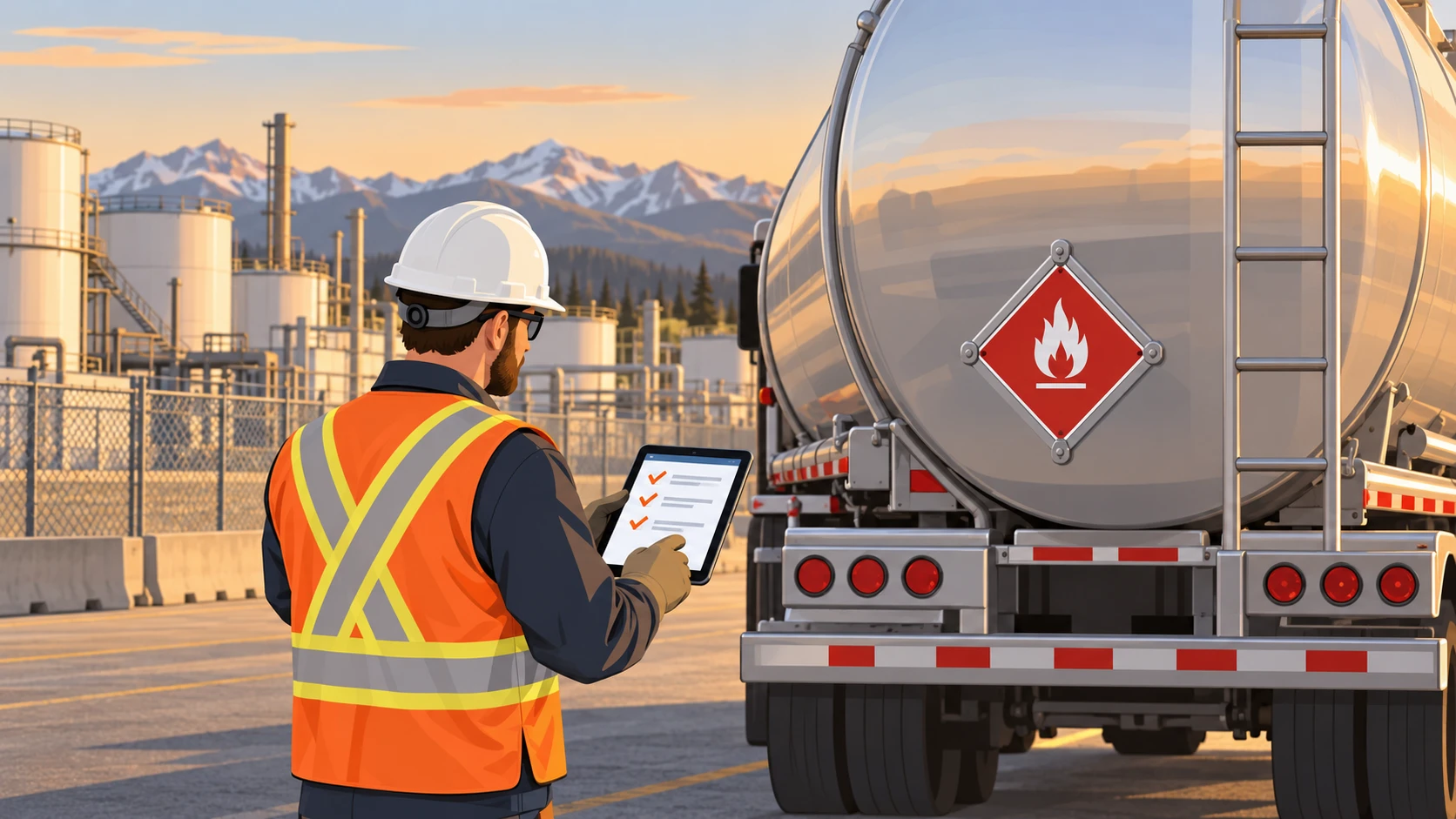
- Anyone who handles, offers for transport, or transports dangerous goods must be adequately trained and hold a training certificate under Section 6.1 of the TDG Regulations.
- "Adequately trained" is duties-based under Section 6.2 — training must match the person's actual job and the goods they handle, not a fixed national curriculum.
- Transport Canada does not approve, audit, or certify any TDG course; the employer decides what's adequate and signs the certificate.
- TDG is federal, so a certificate issued in Alberta is recognized the same way in every province.
- The regulations require an expiry date but don't fix one period — most providers set it at three years.
Anyone who handles, offers for transport, or transports dangerous goods in Canada needs to be adequately trained and hold a training certificate, under Section 6.1 of the Transportation of Dangerous Goods Regulations (TDGR). The catch is in the word "adequately." Section 6.2 defines that as sound knowledge of the topics that relate directly to a person's actual duties and the goods they handle — not a fixed national curriculum. Transport Canada doesn't approve, audit, or certify any training course. The employer decides what's adequate and signs the certificate. That's good to know before you assume a generic course automatically covers you, or before you buy the longest, most expensive option "to be safe."
What TDG Actually Regulates
TDG — the Transportation of Dangerous Goods Act and Regulations — governs how hazardous materials get classified, packaged, documented, and safely moved by road, rail, air, and marine transport across Canada [1][2]. Unlike WHMIS, it's federal end to end: a certificate issued in Alberta means exactly the same thing in Ontario or Nova Scotia, with no separate provincial layer to add on top [3].
That national consistency is part of why TDG certification is one of the more portable safety credentials a worker can hold. It's also why so many providers sell it as a single, standard product — which tends to obscure the part that actually varies: what the training needs to cover for a given person's job.
The Rule Most People Miss: "Adequately Trained" Is Duties-Based
Section 6.1 of the TDGR requires that anyone who handles, offers for transport, or transports dangerous goods either hold a valid training certificate or work in the presence of, and under the direct physical supervision of, someone who does [4]. Direct supervision here means physically accompanied — not a camera feed or a remote check-in [4].
Section 6.2 then defines "adequately trained" as having sound knowledge of the specific TDGR topics that relate to that person's duties and to the dangerous goods they're expected to handle [4][5]. Transport Canada's own guidance gives a concrete example: a highway tank driver who only ever hauls Class 3 flammable liquids may only need training specific to Class 3 goods. Broader training on the other eight classes is a nice-to-have for that driver, not a legal requirement [4].
Flip that around and the gap becomes obvious. A generalist course covering all nine classes in two hours isn't automatically "enough" for a supervisor who signs off on shipments across multiple hazard classes — and a narrow course is not automatically insufficient for a driver who only ever moves one type of product. Adequacy is about the fit between the training and the job, not the length of the course.
Who Needs a TDG Certificate, by Role
Training obligations look different depending on what someone actually does with dangerous goods. This is where a lot of employers either over-train (paying for comprehensive courses everyone doesn't need) or under-train (assuming only drivers need certification).
| Role | Typical Duties | What Section 6.2 Requires | Common Gap |
|---|---|---|---|
| Driver / Carrier | Transports one or a narrow set of dangerous goods classes | Sound knowledge of the specific classes they haul, plus placarding and emergency response for those classes | Drivers who occasionally haul mixed loads outside their usual class often aren't re-trained for the new class |
| Shipper / Consignor | Classifies goods, selects packaging, prepares shipping documents | Full classification system, shipping document rules, and safety marks across whatever classes they ship | Under-trained on placarding for classes they ship rarely, since day-to-day work is dominated by one or two common ones |
| Consignee / Receiver | Accepts, unloads, or stores incoming dangerous goods shipments | Enough knowledge to recognize hazard classes and safety marks, and respond correctly to a damaged or leaking shipment | Often skipped entirely — employers assume only the sending or hauling side needs training |
| Supervisor / TDG Coordinator | Oversees the TDG program, issues certificates, manages compliance records | Comprehensive knowledge across all nine classes, plus the certificate issuance and recordkeeping requirements in Section 6.3 | Given the same short course as front-line workers, when the role actually calls for a longer, more comprehensive program |
What an Online TDG Course Covers
Most general-purpose online TDG courses walk through the same core structure: the nine classes of dangerous goods, shipping documentation requirements, placards and safety marks, the different means of containment, and emergency response planning basics [6]. Course length varies more than the content list suggests — shorter generalist courses run roughly two to four hours, while comprehensive programs aimed at supervisors and coordinators can run past ten hours [7][8].
A valid training certificate itself has to include specific information under Section 6.3: the employer's name and business address, the employee's name, an expiry date preceded by the words "Expires on," and a description of the aspects of TDG the person was trained on [5]. There's no standard template — an employer (or a self-employed person, signing their own) has to actually issue this, not just hand over a course completion badge [4][5].
There's No Official Course Accreditation — Here's What That Means
This surprises a lot of people who assume TDG training works like a licensing exam. It doesn't. Transport Canada has not issued a required curriculum, and it doesn't examine, approve, or certify third-party training courses or instructors [4]. The TDG Directorate maintains a list of organizations offering training, but explicitly does not vouch for the content of any of them [9].
That puts the judgment call on the employer: pick a competent trainer, and decide whether the course actually covers what that specific worker needs [4][9]. In practice, this means the certificate is only as good as the course behind it — and an employer who signs off on training without checking whether it matches an employee's actual duties is the one holding the compliance risk if an inspector asks questions.
How Long a TDG Certificate Is Valid
The TDGR itself doesn't set one fixed national expiry period — it requires that a certificate state an expiry date, full stop. In practice, the overwhelming majority of recognized training providers set that period at three years from the date of course completion [3][6][7]. Employers are expected to reissue training before that date passes, and most providers also recommend re-signing or renewing if an employee changes jobs, changes employers, or starts handling a different class of dangerous goods than their original certificate covered.
Which Course Length Actually Fits Your Role
Don't default to whatever course is fastest or cheapest without checking it against what Section 6.2 actually requires for the job.
- Single-role worker, one class of goods, one employer: A standard two-to-four-hour generalist course covering the nine classes is usually adequate — but confirm with your employer that it explicitly covers the class or classes you'll actually handle.
- Employer training a mixed team: Don't put a supervisor or TDG coordinator through the same short course as a single-commodity driver. The coordinator role calls for the more comprehensive option; a narrow driver role may not need it.
- Self-employed: You can sign your own certificate, but you're also the one deciding what's adequate. Keep a record of why you chose the course you did.
- Renewing an existing certificate: If your duties or the goods you handle have changed since your last certificate, don't just re-take the identical course by default — check whether it still matches what you do now.
Next Step
If your team needs TDG certification that actually reflects the duties-based training rule under Section 6.2 — not just a generic pass-through course — Safeworks Academy's online TDG training can be completed at your own pace, with a certificate issued the same day. Visit courses.safeworksacademy.ca to register.
Frequently Asked Questions
Yes. TDG is a federal standard under Transport Canada, so a certificate issued in Alberta is recognized the same way in every other province, with no separate provincial layer required.
It depends on the course and the role it's built for. Generalist courses aimed at drivers, shippers, and receivers typically run two to four hours, while comprehensive programs for supervisors and TDG coordinators can run ten hours or more.
The employer issues and signs it. A self-employed person can sign their own.
The regulations require every certificate to carry an expiry date, but don't fix a single national validity period. Most recognized providers set it at three years from course completion.
Only under the direct physical supervision of someone who already holds a valid training certificate — meaning that person is physically present, not monitoring remotely.
No. Transport Canada doesn't examine or accredit training content or instructors. Employers are responsible for choosing a competent trainer and judging whether the training is adequate for each employee's duties.
Sources
- Government of Canada, Transport Canada — "TDG Bulletin: TDG Training" — tc.canada.ca
- Government of Canada, Transport Canada — "Part 6 – Training" (TDGR) — tc.canada.ca
- Danatec — "TDG Online Training" — danatec.com
- Canadian Centre for Occupational Health and Safety (CCOHS) — "Transportation of Dangerous Goods (TDG) – Training (Road)" — ccohs.gc.ca
- J. J. Keller Compliance Network — "Training: Canada" — jjkellercompliancenetwork.com
- Calgary Safety Consultants — "TDG Training and Certification" — calgarysafetyconsultants.ca
- Workplace Safety & Prevention Services (WSPS) — "Transportation of Dangerous Goods" course page — shop.wsps.ca
- Danatec — "56 TDG Online Training" course outline — danatec.com
- Government of Canada, Transport Canada — TDG Directorate training organization list reference, cited within TDG Bulletin: TDG Training — tc.canada.ca
Disclaimer: This article is for general informational purposes and does not constitute legal or regulatory compliance advice. Employers should confirm their specific training obligations under the TDG Act and Regulations directly with Transport Canada or a qualified compliance professional.